

It's getting closer

Over the last two decades, a handful of tech terms have become everyday language. Three great examples are “the cloud” (you can thank steve jobs for that one), “digital,” and “platform.” We can now confidently induct “Ai” into that hall of fame.
Like the buzzwords before them, Ai is being quickly, and in most cases, wrongly bolted to every marketing campaign and PR statement of 2023.
What exactly is Ai?
If you want to take advantage of this incredible technology or avoid curling into a ball in fear, you need to get a basic grasp of the basics.
In basic terms, AI is a branch of computer science with the goal of creating machines that can perform tasks that typically require human intelligence.
This isn’t a new technology. Work on artificial intelligence dates back to the 1950s. But in the last few years, the computing power available has allowed reality to start feeling more like science fiction.
The five main branches of Ai
Natural Language Processing (NLP)
Machine Learning
Robotics
Computer Vision
Expert Systems
Don’t panic. This isn’t going to turn into a ted talk. But I do need to expand a little on the first two. Natural Language Processing and Machine Learning
Look who’s talking
It’s Natural Language Processing (NLP) that’s generated the majority of the buzz since the release of GTP 3.5 back in November last year.
NLP is the AI branch that aims to teach machines how to understand and talk like humans. It uses algorithms to analyze and interpret the meaning, context, and purpose behind words and sentences.
In otherwords NLP makes using a computer feel you’re talking to a human.
If you’ve used ChatGPT, then you’ve already experienced NLP for yourself. At first, it can be quite an odd sensation for the user, as it can really feel like you’re talking to another human, albeit one that is firmly on the spectrum.
Smart machines
Machine learning is like teaching a computer to learn on its own. Just like how you learn from experience, a computer can also learn from examples and data.
For example, let's say you want to teach a computer to recognize whether a picture has a cat in it. You would show the computer a lot of pictures of cats, and the computer would try to find patterns in those pictures that are common to all cats, such as pointy ears, whiskers, and a tail. Then, when the computer sees a new picture, it can compare it to what it has learned and decide whether or not there's a cat in it.
Machine learning can be used for all sorts of things, like predicting what products you might like to buy or even diagnosing diseases based on medical data.
2+2 makes five
ChatGPT combines NLP and Machine learning, pulling its core information from a 570 GB database of general knowledge provided by the team behind the project.
The end result is the very real sensation; you’re talking to a machine that’s thinking for itself. 2+2 = 5
Yes, the truth is you are simply accessing a hard drive of information half the size of the one on the laptop I’m using right now.
Yet if you use ChatGPT, you’ll quickly discover it seems to know almost everything there is about everything. That is the power of NLP and machine learning.
The technology is able to look at limited sets of data and reason new answers using logic. It’s this ability that is perhaps the program’s most human characteristic.
Important note: ChatGPT (currently) doesn’t have access to the internet. Or, more accurately, today’s internet. The open Ai project capped the data on the last release to late 2021.
In many ways, it’s the computer equivalent of a mentalist. It pieces information together from clues it pulls together from the information you provide.
The more information the program has, the more learning it can do. The more learning, the better its responses become and the more human-like the machine begins to feel.
Remember when I said the current model is using 570GB of data? Well, I’d like to put that figure into some context for you. In comparison, the latest estimates of the Google database put its size in the region of 15 Exabytes. Yes, I know what you’re thinking. What the hell is an exabyte? Let me hand this one over to chatGPT.
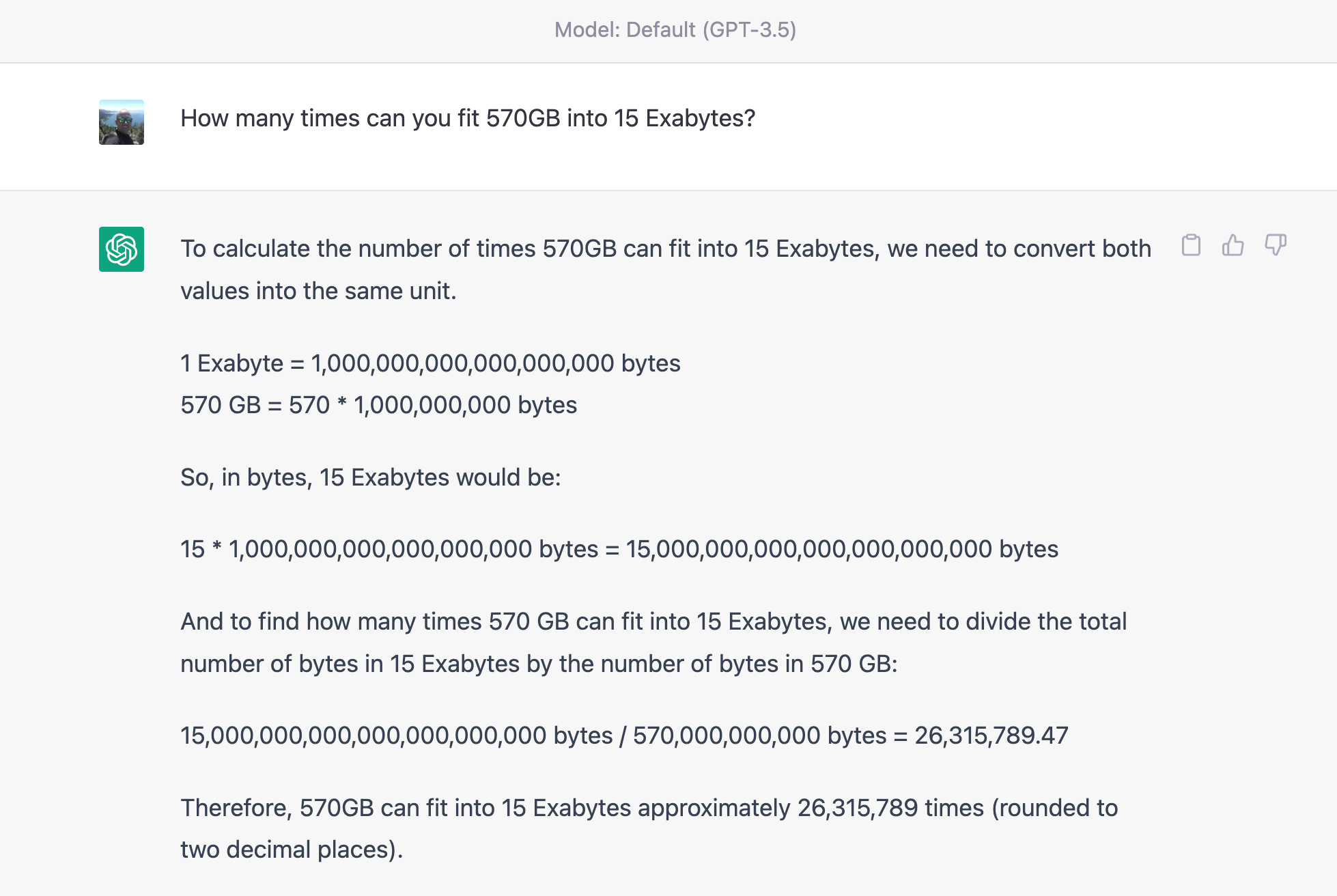
Or, to put it another way, Google has 26 million times more information than the current chatGPT database.
With each update (today, we are at version 4.0), they increase the size of the database the program can access. But remember, it also has access to the questions being asked by the billion+ visitors to the website each month as well.
Today
The program is getting smarter and smarter every second of every day. The jump in intelligence from each release is hardly visible to casual observers, but behind the scenes, the leaps are staggering.
“GPT - 4 passed a simulated bar exam with a score around the top 10% of test takers,” OpenAI added. “In contrast, GPT-3.5’s score was around the bottom 10%.”
Most experts believe that version 5 will easily pass the entrance exam requirements of the most prestigious universities. This is all in the space of only a few short months. (the open Ai project is around eight years old, but until version 3, the results had been less than impressive)
We are rapidly heading towards an event that six months ago was considered science fiction.
Artificial General Intelligence (AGI)

We have now reached a tipping point where Ai is beginning to improve itself. This is yet another domino in a series that leads to what’s known as AGI, or Artificial General Intelligence.
Artificial Intelligence (AI) can perform tasks that typically require human intelligence, such as recognizing faces or understanding language. AI systems are programmed to perform specific tasks and can get better at those tasks with practice, but they do not have the ability to learn on their own.
Unlike its Ai cousin, Artificial General Intelligence (AGI) is a type of AI that aims to create machines that have human-like intelligence and can learn and adapt to different situations just like humans can. This means that AGI machines can perform a wide range of tasks and can continually improve their performance without being explicitly programmed for every new task.
In simple terms, AI is like a computer program that can do specific things, while AGI is like a machine that has human-like intelligence and can learn and adapt to new situations just like humans can.
Until recently, the general consensus was AGI was either an impossible fantasy or at least decades away. That all changed a few weeks ago when Elon Musk, along with several other technology leaders, issued an open letter requesting that Ai development be halted for six months so that safeguards could be put in place.
This level of “desperation” on the part of some of the smartest people on the planet gives you a real insight into the speed at which things have accelerated in the last few months.
Almost everyone has been caught off guard.
What next?
Ignoring the very real existential threat to mankind that AGI might present (very soon, humans might not be the smartest thing on the planet). The move towards AGI “light” systems that are able to improve themselves will fundamentally change the world forever.
As recently as this past 24 hours, a new program referred to as Auto GPT or Baby AGI has been taking the tech world by storm.
This new software uses something referred to as Autonomous Agents to work with the Ai to perform complex tasks without human involvement.
In theory this new stage in development will allow Ai to begin to make decisions based on feedback its generated for itself.
Now we have the basics out of the way, start looking at how this technology is already impacting businesses and explore the incredible possibilities it presents in the very near future.